
Author: Ruth Whippman
Publisher: Quercus, London, 2024
The author, Ruth Whippman, was brought up as a feminist and sees that bringing up three sons is difficult today and explores in this book how boys are brought up differently than girls.
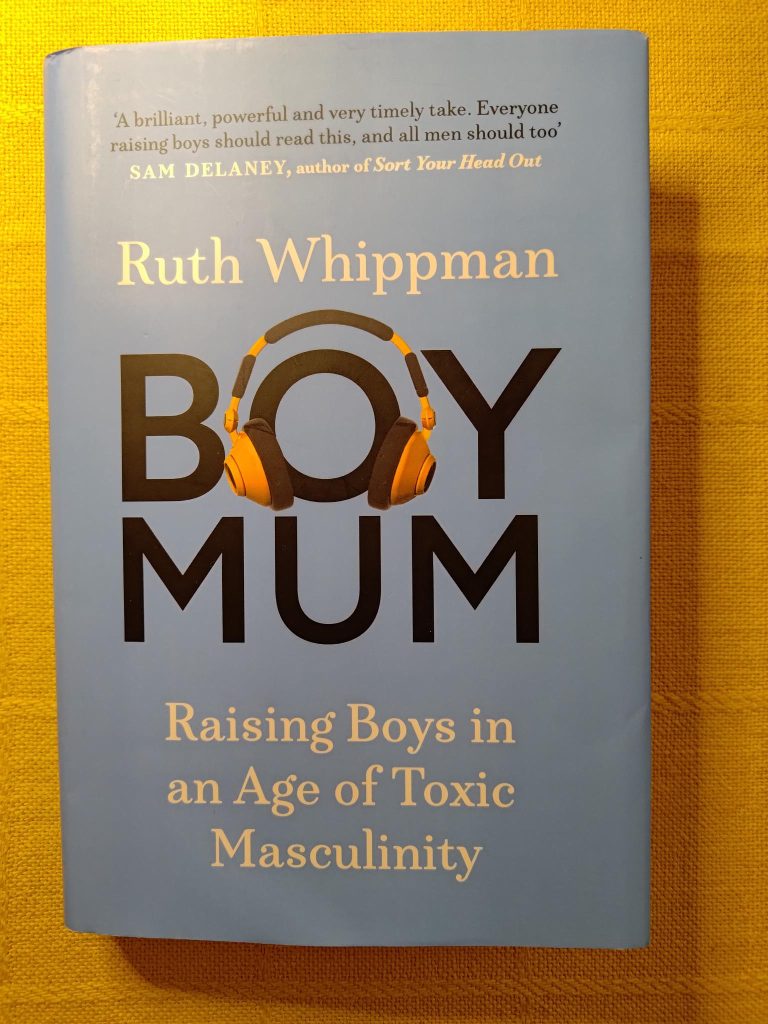
I can’t say that I enjoyed the book, but I did find the topic interesting. My son is now in his 40s, but I do have a grandson born in 2025, so found the topic relevant for my daughter who is bringing up a son. Though one has limited time to read when both working and bringing up children, it is certainly a book to make one think carefully about how gender roles are taught in the society that we live in.
Many of you who read my blogs are grandparents and you may find that reading this blog gives you an overview of the ideas and there is no need to read the book. On the other hand, if the topic interests you, the author has lots of stories and information in her book. I found several of the chapters a bit disturbing as society has changed since I was a child. Children always get inundated by expectations from their parents, their teachers and their peers. However, I’m finding that today’s society does not support the diversity that I feel is necessary for a healthy world, though you may disagree with me.
The book has eight chapters as well as an introduction and an epilogue. The author brings out many good points about how we learn to be either a man or a woman. You can think back to your own childhood, or parenting years, and think about what the expectations were. Socialization is different for girls and for boys, whether we like it or not. We need to discuss more openly what we really expect of our children, or grandchildren, while they growing up.
Throughout the book, the author tells stories about specific individuals, but also quotes experts in various fields and what the research shows or doesn’t show. She seems to have interviewed a lot of people over several years, and shares what she has learned through these conversations.
Introduction – #Metoo Baby
In general, boys are seen as more difficult to raise than girls. The author has three energetic boys and feels difficulty coping with the job of raising them, even with the help of their father. The introduction to the book shows what her personal background is and the context of society around her as she starts on this project of writing the book which seems to have gone over at least three years.
Chapter 1 Boys Will Be Boys – Off to a Bad Start
So much of boys’ behavior is put down to their genetics/biology of being male. But how much is the biology of being male, and how much is how they are brought up? There are certainly differences between boys and girls and the author is trying to figure out how much is nature and how much is nurture. But already as babies, parents give their infant boys “less positive touching, such as hugging, cuddling, rocking and soothing than they give their baby daughters”. (page 31)
Chapter 2 “Girl Stories” – What We are Failing to Teach Boys about Being Human
Girls are raised differently than boys and in this chapter the author goes into some of these differences which start early in life. Girls are expected to like certain things and activities and boys are expected to like different things and activities, already from a young age. Girls are taught to value friendship and understand emotions. Boys are expected to be heroes and enjoy fighting. “Cultural stories push boys away from quiet reflection and empathy, towards fighting and competition and aggression.” (page 70)
Chapter 3 Boy Stories – The Scripts of Masculinity
How do boys learn to become men? There are all sorts of conflicting messages being given, through books, films, games and real life situations. By talking to young men who have had difficulties, the author expands our knowledge of how difficult some boys find the challenge of growing into successful men. “The silent stoicism and lack of emotional openness that masculinity demands can be damaging.” (page 82) The author gives several examples of how things can go wrong. “Boys don’t need more masculinity, but freedom from that paradigm; they need permission to be fully human without the pressure to conform to oppressive masculine norms.” (page 107)
Chapter 4 “Feminizing the Classroom” – Boys and School
In general, girls do better at school than boys. The classroom rewards those who can sit still, like to learn and have good control over their behavior. “A fair amount of evidence shows that the ways in which we socialize boys do have an impact on both their attitudes towards school, and the performance and behaviour in the classroom.” (page 121) “We know that the discrepancy in grades and academic performance between boys and girls in not related to their intelligence. The differences between boys and girls that impact their school performance are largely social-emotional and behavioural ones.” (page 129) The author urges changes in the classroom culture so that social skills and emotional connection are emphasized. (page 134)
Chapter 5 Hyperconnection and Disconnection – Boys Online
In this and the next three chapters, the author discusses how boys, teenagers and young adults are reacting to the way they are expected to be “masculine”. Going online, playing a lot of games, comparing themselves to others, is all part of the modern way boys spend their time. With small children, screens give parents a break, but when screen time becomes extreme, things can go wrong. When young people do not spend time with each other in person, it is not easy to learn how to develop into a well-functioning adult. But this is also the chapter where the author admits to the diagnosis that her young boys have been given – ADHD and autism – scary things to have to handle. But medication for ADHD helps calm the boys down and life goes on.
Chapter 6 Angry Lonely Boys – Conversations with Incels
Chapter 7 “Rape-Con”
Chapter 8 Sex and Sexism
These three chapters contain interviews with boys to illustrate how sexuality affects teenage boys and young adult men. I’ll let you read those chapters if you want more information. I found them depressing to read as they are about the boys who are not functioning well.
Epilogue – What Do we Do About it?
This should be the chapter where we find out how to avoid the problems in the previous chapters, but of course, that would be too simple for a very complex problem. There are lots of things that have to change, including the way we address young girls (“Sweetheart”) and young boys (“Buddy”). But the problem needs to be tackled so that men and boys gain “freedom and connection, an opportunity to become more fully human.” (page 269)
We have to acknowledge that there is a problem. We have “to encourage our boys to become more attuned to other people’s needs and emotions in the same way that we have always expected girls to be.” (page 274)
The author has few suggestions for improvement but encourages the reader to work for improvements in the society around them. Every little change can make the world better.