I made a decision a while ago to buy locally produced food when it was conveniently available at a competitive price. I don’t buy everything that might be available as it must be things that we use.
Two of the products that are produced on local farms in our neighbourhood are eggs and milk.
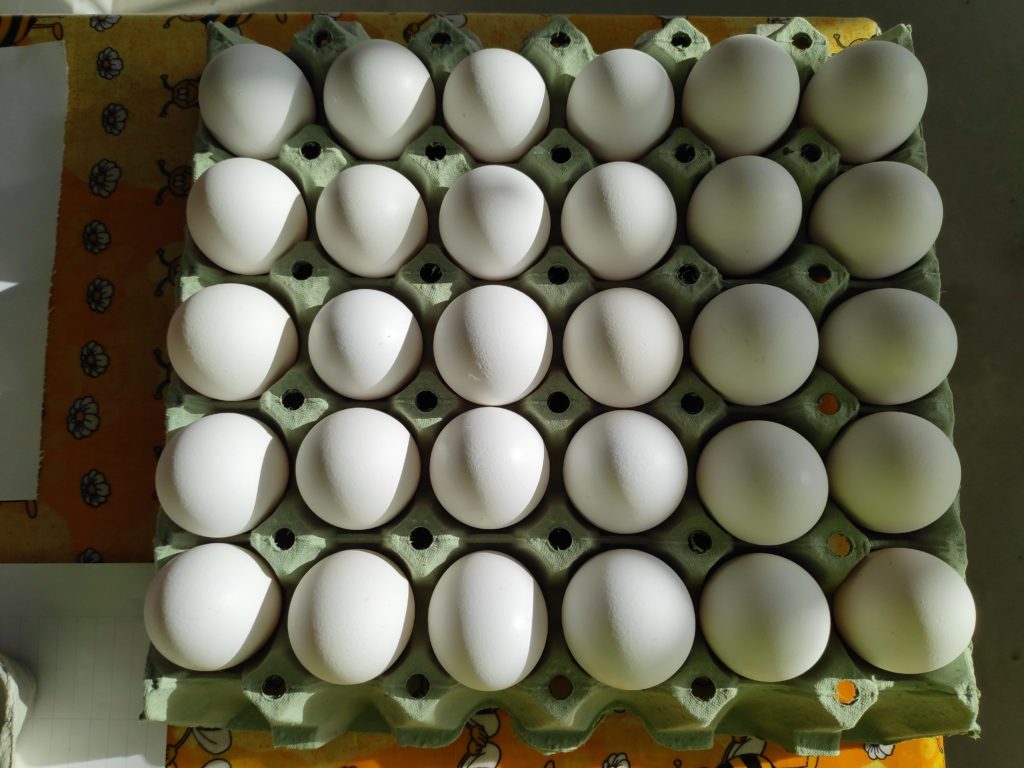
I started buying eggs quite a while ago now. It is a short walk up to the neighbouring farm. We get 30 eggs at a time and we can also buy double-yoked eggs or cracked eggs at differing prices. I buy just the regular eggs.
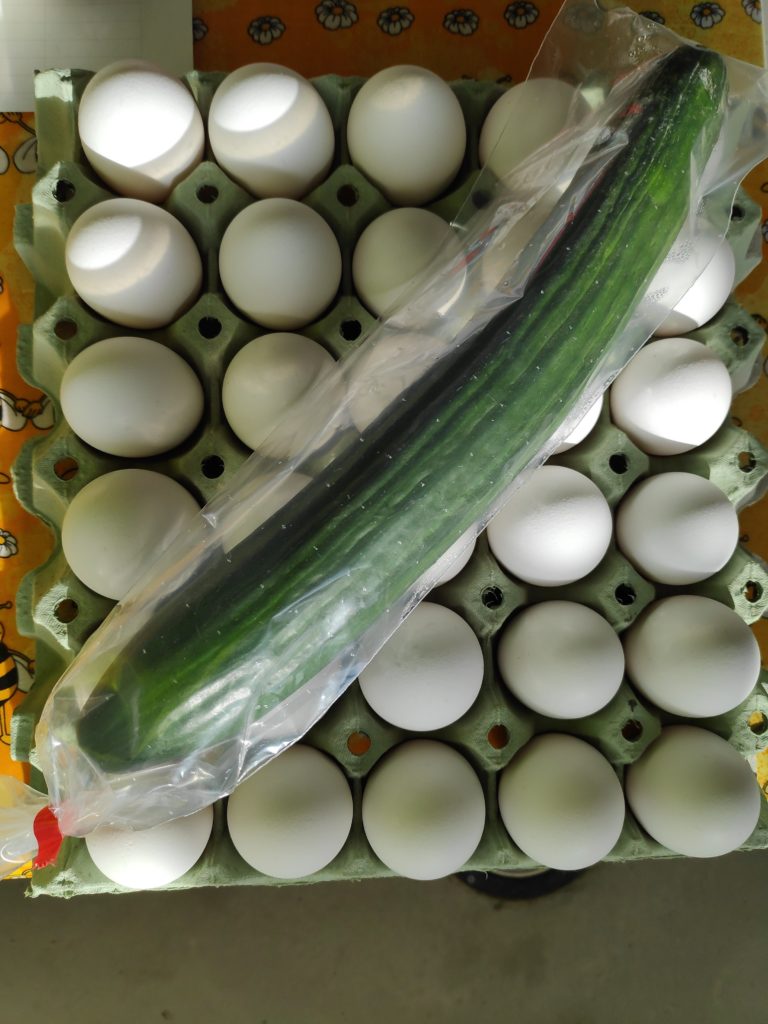
In addition to eggs, I can also get cucumbers at the egg farm, though the cucumbers are produced at another farm in Inderøy. Though I don’t purchase it, I can also buy honey here, produced by the farmer’s wife. I find their price a bit high, so have only purchased it once.
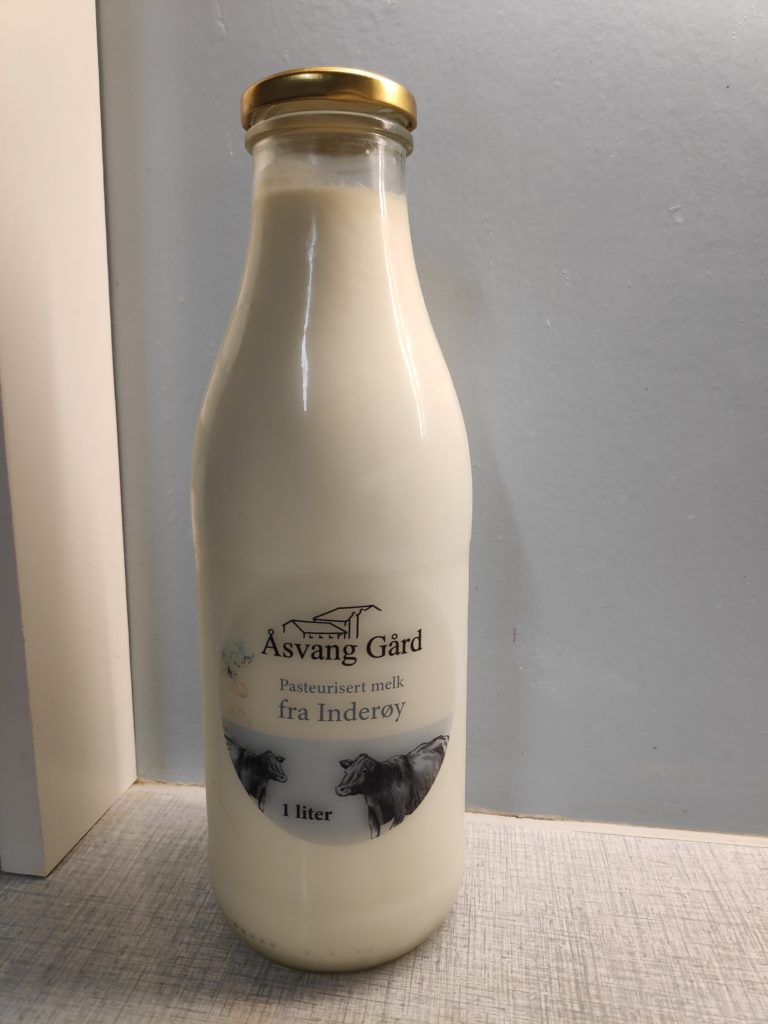
I also buy my whole milk in a bottle at a farm that is just a little bit farther away, but still within walking distance. I usually get two liters of milk at a time. One pays a deposit on the bottle on the first purchase and after that one returns the empty bottle and only pays for the milk itself.
In both cases I use a small backpack to carry home the food. Eggs are put into 12-egg cartons which nicely fit in the backpack. Two or three liters of milk also fit nicely into the backpack, though not both eggs and milk at the same time.
To pay for what I purchase, I can use my telephone to send the money while I am at the farm. No invoices or delayed payment. I pay when I take the food. I often meet the farmers and it is nice to chat to them for a few minutes.
This is one way that I can contribute to farmers trying out new marketing ideas.
Many years ago now I made a sourdough starter and used it for making bread. Though I still make my own bread, I now use bought dry baker’s yeast to leaven my bread. When my daughter mentioned making a sourdough starter I found my old recipes and decided to share them here. I have no idea now where I got the recipes from. Thank you to the person who shared them with me.
Sourdough starter
4 medium-sized potatoes, peeled and chopped
14 dl cold water – add to the potatoes. Bring to the boil and cook the potatoes until tender.
Mash the potatoes in the water, and make a smooth mixture.
Add 1 dl sugar and let stand until lukewarm.
Stir one package of active dry yeast into 2 dl of lukewarm water. Add 1 tsp sugar. Let foam for 10 minutes.
Add to the potato mixture. Cover with a cloth. Let stand overnight in warm room temperature until slightly sour or for two days for a tangy flavor.
Refrigerate in a sterilized jar.
To use sourdough starter
Take out 2.5 dl of starter and let it warm up to room temperature, about 1 hour
To the remainder, add 0.5 dl sugar dissolved in 2.5 dl lukewarm water. Stir well.
Any time you use some of the starter, you must replace it with sugar and water to keep it going.
If the starter is not used at least once a week, feed it with one teaspoon of sugar.
Sourdough bread – 4 loaves
2.5 dl sourdough starter
1 liter lukewarm potato water
0.5 dl sugar
0.5 tsp salt
3 tbsp oil
1 kg whole wheat flour
appr. 1.5 kg white flour
Use a bread mixer if you have one as it will save you a lot of hard work. Mix the sugar and salt into the warm water, then add the starter. Add the oil, and the whole wheat flour. Mix quickly by hand then do the rest by machine. Add as much white flour as is needed to make a dough that stays together, is smooth, and comes away from the edges of the bowl. Place in a large bowl and let rise until double in size, usually about one hour.
Turn out the dough onto a floured baking board. Divide the dough into four equal parts. You can make four loaves, or perhaps you would like some buns out of one of the parts. You can shape the loaves as round bread and place on a baking sheet, or you can use loaf pans. Let rise until double in size.
Bake at 190 degrees C, 45 minutes for bread, about 25 minutes for buns. Cool thoroughly on a rack.
After watching a Norwegian television series, I have decided to use more barley in our diet. Barley is grown in Norway and is actually more suitable to the Norwegian climate than wheat. Wheat can be grown in Norway, but it will vary from year to year how self-sufficient Norway is, depending on the summer weather. Some years Norway can provide 75% of the wheat it needs, and other years perhaps only 20%. So by using barley instead of wheat I can use a grain grown in Norway.
At my local food store I can buy either whole barley grains or whole-grain barley flour. I have been using both in our meals this last week.
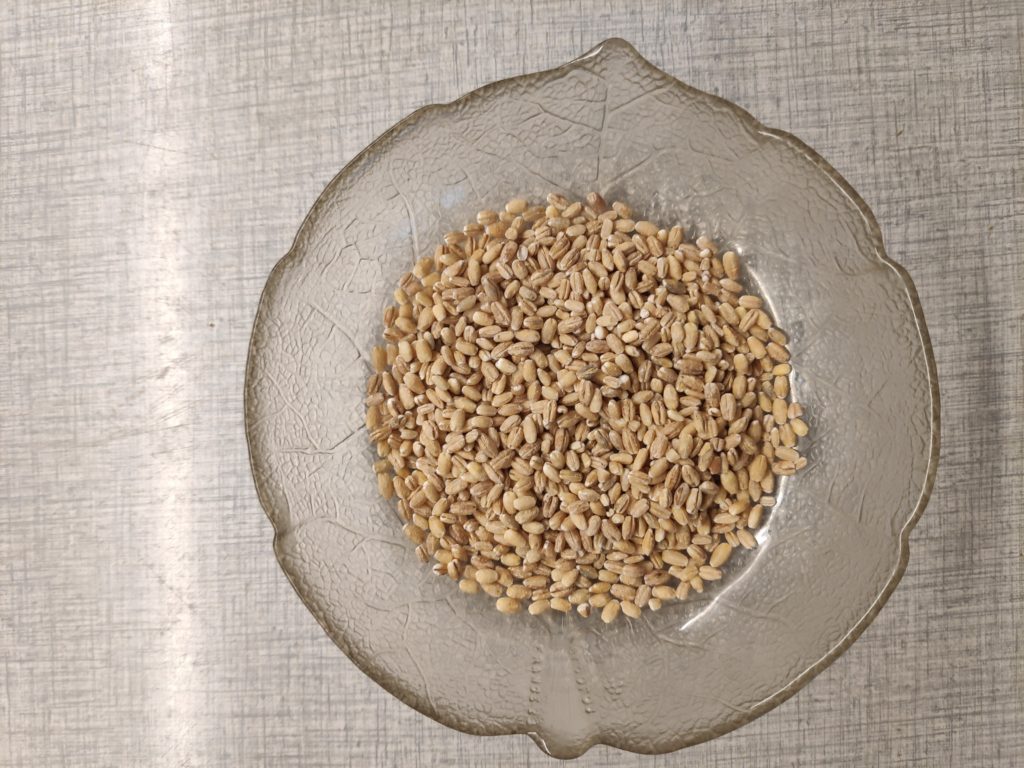
Uncooked barley grains
Whole barley grains need to be soaked before using, so that one needs to plan the use of them ahead of time. We usually have a turkey at Christmas time, a childhood tradition for me. The day after turkey day, I like to make turkey soup, boiling the turkey bones to make a rich turkey stock and then adding grains and vegetables to make a hearty soup. This year I bought barley and added it to the soup and it was delicious!
Barley can also be used as a substitute for rice, which is an imported food in Norway. I have used it in various dishes and enjoy the taste of it. It is slightly crunchier than rice and takes about the same length of time to cook as brown rice though it needs to be soaked ahead of time. Use cooked whole grain barley in vegetable dishes to provide the carbohydrates needed to make one feel full and give the energy one needs to do things. It is very good in soups and stews.
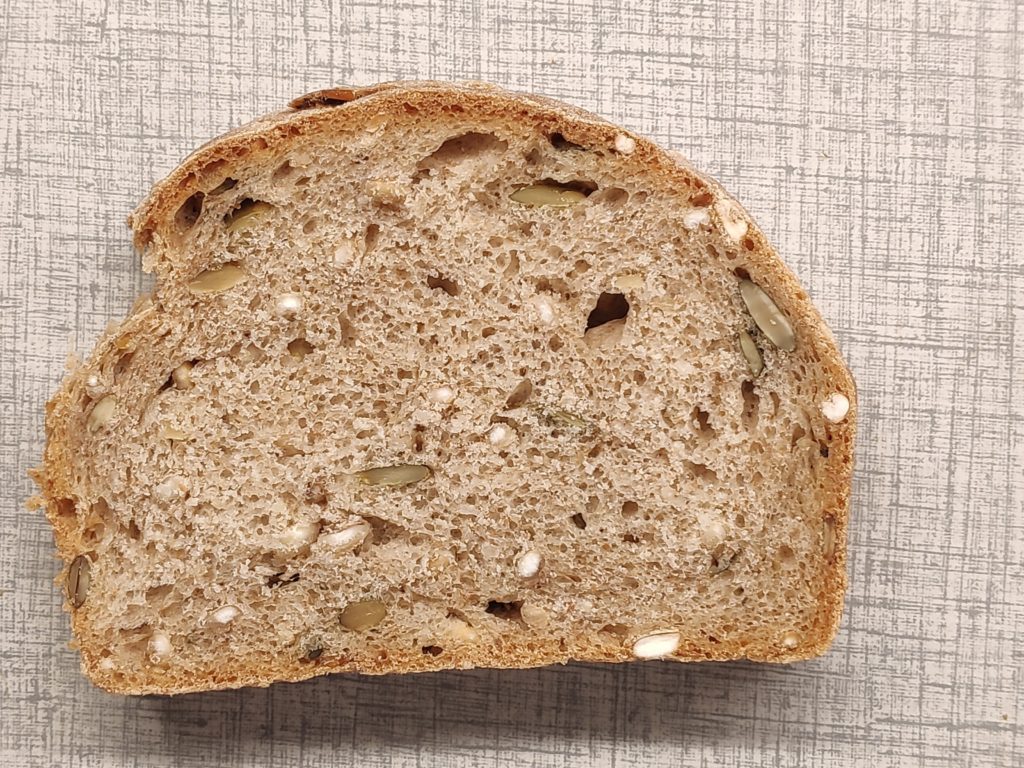
On the package of the barley grains, there was a recipe for using barley grains in bread, so I tried that this week. The grains as well as some barley flour were first soaked for an hour. Then the rest of the ingredients were added. This means that the barley grains were not cooked before being added to the bread dough. The recipe also called for pumpkin seeds, so it was a very crunchy bread.
Bread made with whole barley grains and pumpkin seeds.
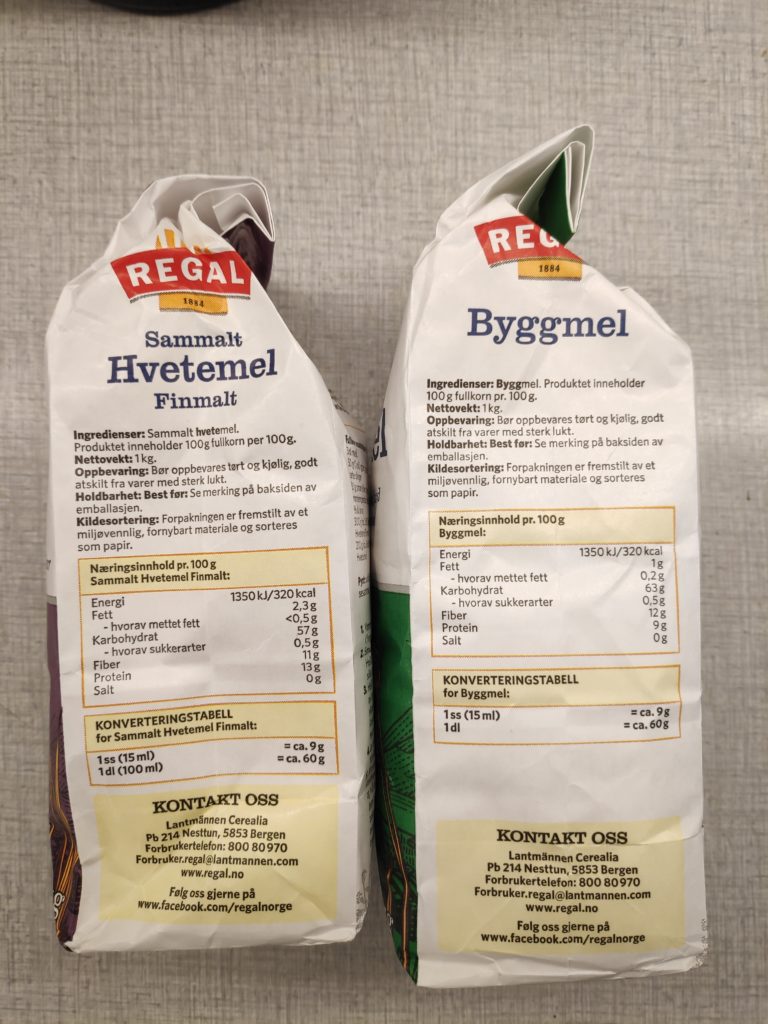
If we look at the nutritional content of barley flour and compare it with whole wheat flour there isn’t a lot of difference. They both have the same amount of energy, 1350 kj / 320 kcal. Wheat flour has more fat in it, at 2.3 gr while barley flour has only 1 gr. However wheat flour has less carbohydrates at 57 gr as versus barley flour at 63 gr. Barley flour has more fiber at 12 gr than wheat flour at 11 gr. Wheat flour has more protein at 13 gr while barley flour has only 9 gr. Whole grain barley has slightly more fat (3 gr), less fiber (8 gr) and less protein (8 gr)
I use whole wheat flour when making pancakes or waffles, which we have regularly once a week for breakfast. This week I substituted barley flour for some of the wheat flour to see what the taste difference is. I actually liked both the pancakes and the waffles with the barley flour. They were a bit more substantial than the regular ones that I make with only whole wheat flour. I think this is something that I will continue to use.
Barley flour will not rise like wheat flour, so though one can substitute some of the wheat flour, one cannot use only barley flour in bread that is meant to rise. It can, however, be used in flat breads or crispbreads, though I haven’t tried it yet.
The micro-nutrients found in barley can be important in a vegetarian diet. (Source: https://en.wikipedia.org/wiki/Barley#Nutrition) Barley is a good source of:
calcium
iron
vitamin B6
niacin (B3)
manganese
magnesium
potassium
phosphorus
zinc
Much of the barley produced is used in making alcoholic beverages such as beer and whisky. As I do not consume alcoholic beverages I will not go into this use of barley. Barley is also used as animal feed.
I recommend using more barley in your diet as it is nutritious and tasty.
After watching a program from Norwegian television (NRK) called Line fikser maten (Line makes food), I am even more convinced that cutting out meat and fish from our diet is good for both my body and the planet.
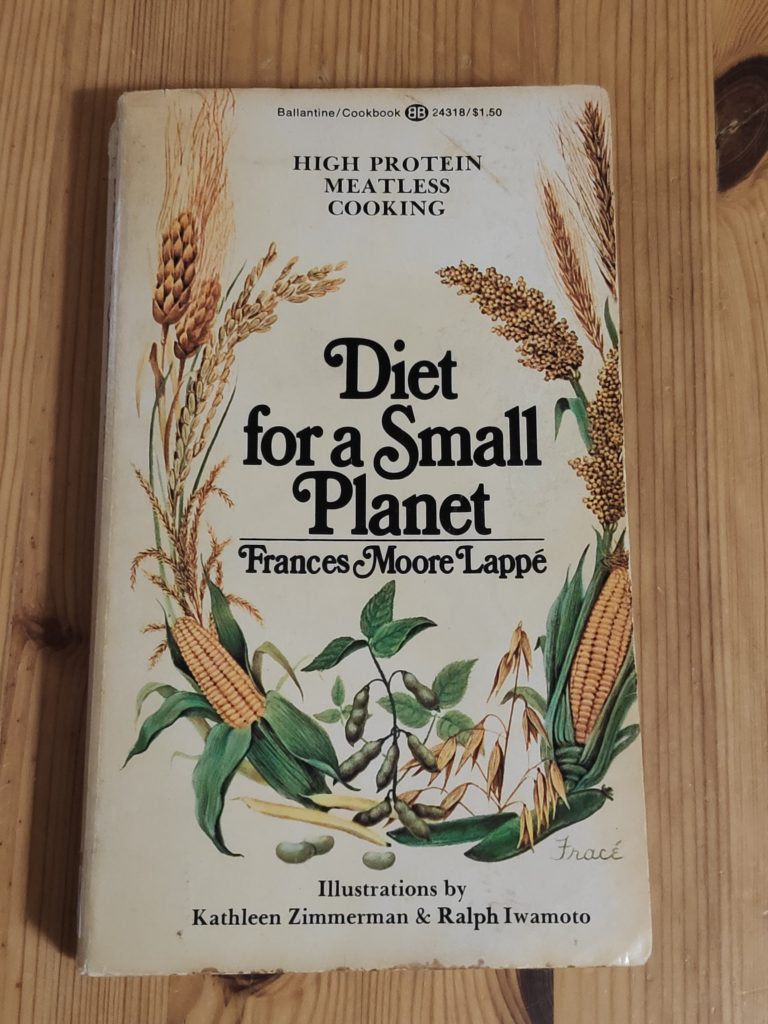
I first became aware of the problems caused by the consumption of meat when reading, Diet for a Small Planet, back in the 1970s. The author, Frances Moore Lappé, was concerned that eating meat was not sustainable on our planet and she showed how one could use plant products to supply the protein we humans need to consume. She showed how to combine foods to create good nutrition and give enough protein on a daily basis. She also provided lots of recipes so that one could get started with creating a new healthier diet.
Published by Friends of the Earth and Ballantine Books, New York, 1971. My copy is from the 12th printing in 1974.
Already at that time, I went over to a diet that used proteins from plant products and reduced my intake of meat, fish and poultry. It has since been shown that one doesn’t need to complement foods in the way that Lappé suggested to get adequate protein, though one should still think carefully about which types of foods should be eaten during the day.
In 1980, my husband and I moved to Norway and had very little money to live on. We lived on the coast, so fresh fish was affordable, but meat was not. We rarely ate meat, except for the occasional ground beef. Poultry was also not nearly so common back then and not particularly cheap, at least for our income level. A wide variety of legumes was not available either, so we lived on quite a restricted diet. I never felt that we had poor nutrition though I do remember trying to buy everything on sale, especially canned goods.
Once we started working in Norway, and our income improved we also started eating more meat and poultry. The cost of meat became relatively cheaper and certainly poultry became cheaper and easier to get hold of. Over the last forty years, the availability of a variety of food has improved and imported food has became much more common.
Now we eat a wide variety of legumes, most of which are imported from Asian countries. Though I do prefer to buy vegetables that are grown locally, not everything is in season year round. As an example I was able to buy the first locally produced tomatoes today and they haven’t been available for several months. Much of our fresh produce comes from Spain, Israel or South Africa.
We live in an agricultural area, surrounded by farms. We have an egg farm as one of our nearest neighbors and we walk up there to buy farm fresh eggs. Some of the farms nearby are meat producers, either beef or pork. Potatoes, carrots and other vegetables may come from neighboring communities. But bananas, oranges and grapefruit are still not grown in Norway. However with climate change and the increasing use of greenhouses to produce plants, there may come a change in what is locally grown in the future.
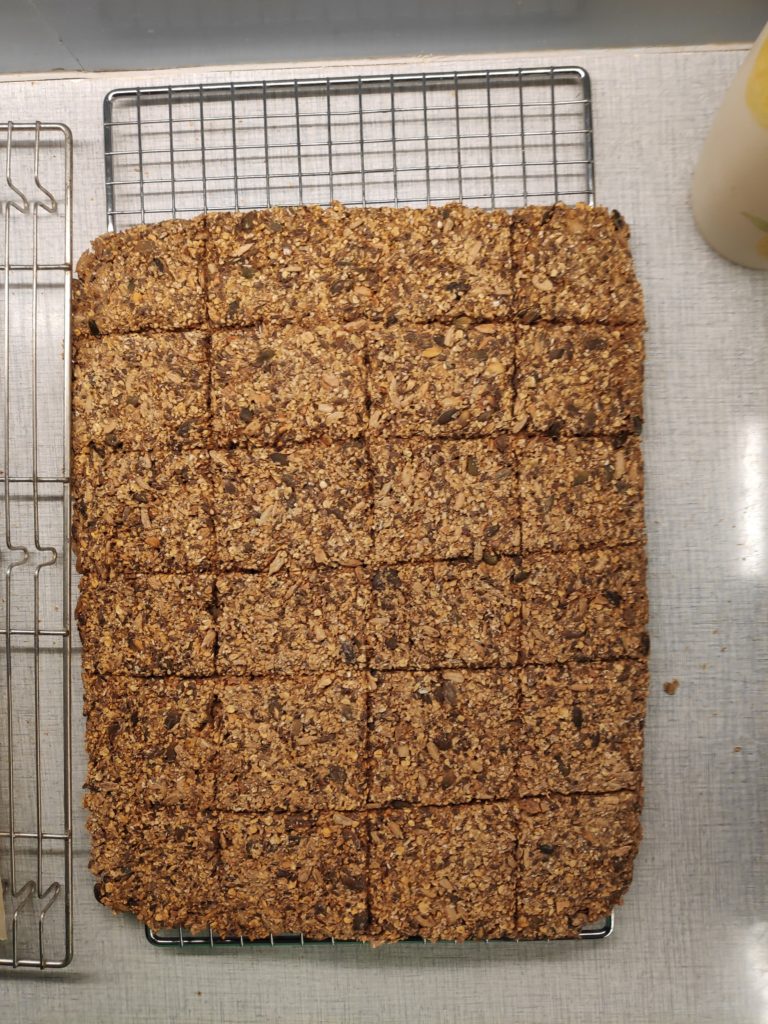
Norwegians use a lot of crispbread, many made by the Swedish company, Barilla, with the brand name, Wasa. Because processed foods often contain many ingredients to make the products have a long shelf-life, I prefer to make my own. Of course, the finished crispbread turns out very different, but I think it is a healthier product. As the life of the finished crispbread is short, maximum a couple of weeks, I do not need a lot of additives. Here is the recipe that I used today, though I can vary what goes into it.
5 dl rye flour, 4 dl coarse flour and 1 dl fine flour
4 dl rolled oats
1 dl chopped almonds
1 dl linseeds
1 dl sesame seeds
2 dl sunflower seeds
2 dl pumpkin seeds
1/2 tsp salt
7.5 dl water
Mix all the dry ingredients first in a very large bowl. Add the water and continue to mix. Let the mixture sit for 10 minutes so that the flour and rolled oats soak up the water. This is what holds all the seeds together.
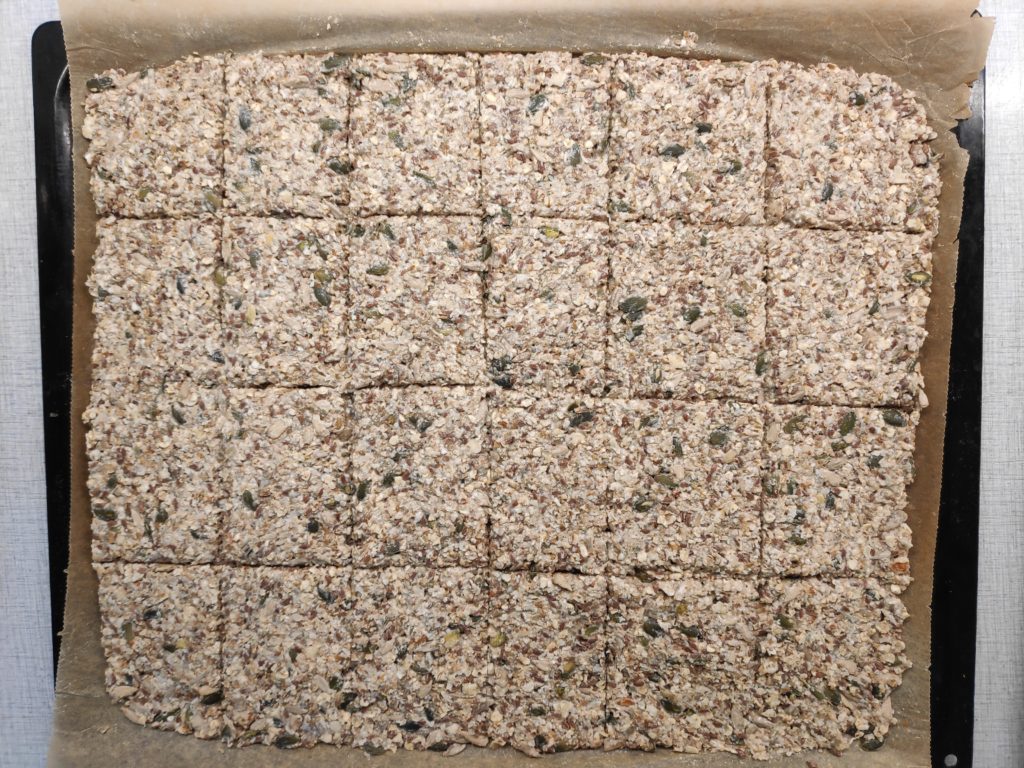
I use baking paper on two cookie sheets and spread the mixture as evenly as possible. Use a bit of time to spread it out smoothly and right to the edges. Before putting it in the oven use a knife to cut through the top surface where you eventually want to break the crispbread into smaller pieces.
Today’s crispbread before it goes into the oven.
Bake the crispbread, both sheets at the same time, using a hot air oven at 160 degrees C. It will take over an hour, perhaps an hour and a quarter. Every 15 minutes, I change which sheet is on top. Opening the oven door will also let the steam out. This is important as you are trying to dry out the mixture. It’s not like a cake that has to bake. You will know that it is finished as it will start to arch and become very crisp. It should also turn a slightly darker color. Do not bake too long, or you will burn it.
When you take it out of the oven, remove it from the cookie sheet and break along the knife lines. Pile on a rack and let cool completely. The crispbread is best stored in an open container as it is meant to be dried out.
Crispbread just out of the oven.
Enjoy your treat. Try it with sliced cheese or humus. Or it can be enjoyed just as it is.
Fats are one of the three main sources of calories for our bodies. Fats are sources of essential fatty acids that the body cannot produce itself, but needs supplied through our food. Fat helps the body absorb Vitamins A, D and E. Fats are also used in cooking as it adds flavor to our prepared dishes.
You get 9 calories (37 kj) from each gram of fat, twice the amount of energy available from either proteins or carbohydrates. When you take in more calories than you use in a day, the excess is stored as fat in the body.
There are three major types of fats: saturated, monounsaturated and polyunsaturated. Most of the fats we consume are a combination of both saturated and unsaturated fats. We should cut down on the saturated fats and rely more on unsaturated fats.
Saturated fat
Most saturated fats come from animal sources, such as meat and dairy products. However palm oil and coconut oil are also high in saturated fats. To lower your intake of saturated fat, you need to reduce your amount of meat, cheese and many processed foods, such as cookies, cakes and pastries.
Monounsaturated fat
Monounsaturated fats are healthier for our hearts and help lower the bad LDL cholesterol levels in our bodies and maintain a healthy level of the good HDL cholesterol. Sources of monounsaturated fats are olive oil, rapeseed oil, avocados, almonds and peanuts.
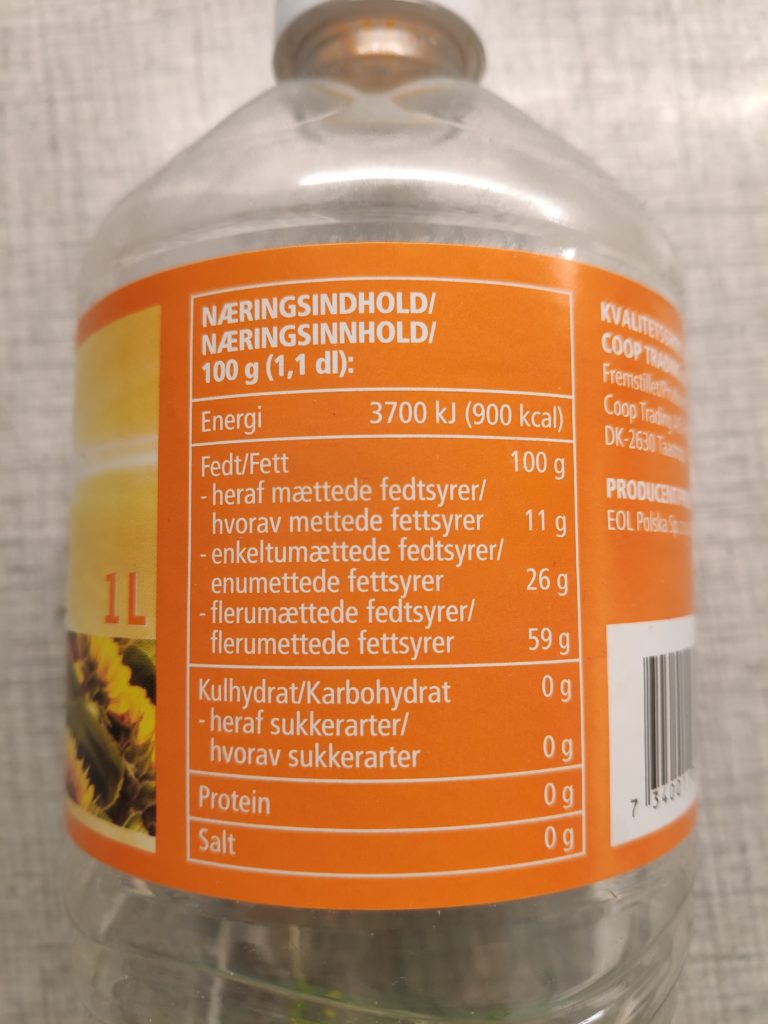
Sunflower seed oil has 11 grams of saturated fat, 26 grams of monounsaturated fat and 59 grams of polyunsaturated fat. Here is a product that has no protein, no carbohydrates and no salt. It is pure fat
Polyunsaturated fats
There are two main types of polyunsaturated fats, omega-3 and omega-6. Some of these cannot be made in our bodies and therefore have to be supplied by our food intake.
We get omega-6 fat from vegetable oils such as rapeseed, corn and sunflower oils. Most people will naturally get sufficient of this type of fat.
We get omega-3 fat from oily fish, such as sardines, salmon and mackerel.
Carbohydrates in our diet provide the energy we need to fuel our body. We get them primarily from grains, legumes, fruits and vegetables. Carbohydrates include starches, sugars and fibers. This is one of the essential ingredients in our food and should supply about half of our calorie intake daily. (The rest comes from proteins and fats.)
The word “carbohydrate” means that on a molecular level they are made from carbon, hydrogen and oxygen. Carbohydrates are divided between simple carbohydrates and complex carbohydrates. This is based on chemical structure and how quickly the energy is absorbed.
Simple carbohydrates have only one or two sugars and are quickly digested and absorbed. They can lead to spikes in blood sugar and are not particularly good for you. Examples are table sugar, corn syrup and fruit juice.
Complex carbohydrates have three or more sugars and take longer to digest. They provide a more sustained energy source and are better for you. Examples are potatoes, lentils, beans and whole-grain breads.
Though you get calories from proteins and fats as well as carbohydrates, you want your body to use proteins to build new muscles, while it uses carbohydrates as the fuel for muscle activity, including brain activity.
Fiber is another part of carbohydrates and is essential to digestion. Fiber is found primarily in fruits, vegetables, grains and legumes. A healthy amount of fiber in your diet helps reduce heart disease and diabetes. It is recommended that a person consume 14 gr of fiber for every 1,000 calories consumed.
Processed foods, such as cereals, pastries, candies, white rice and white bread are poor sources of carbohydrates as you get very little other nutrition for the calories that you consume. Good carbohydrate foods will give you fiber, vitamins and minerals as well as calories.
Here are some good, healthy sources of carbohydrates (and energy):
whole grains
fruits such as apples, berries and bananas
vegetables such as potatoes, broccoli and carrots
beans and legumes
seeds and nuts
(My main source of information was from: https://www.livescience.com/51976-carbohydrates.html although there are many websites that will give you more information than in this article.)
When we want to eat healthily, we have to get the correct combination of food types. There are three main types of food: proteins, carbohydrates and fats. This article is about proteins.
We need to eat protein as part of our diet on a daily basis. It is one of the building blocks of the cells of our body. Our body uses the proteins in the food we eat to build muscle and to provide energy for our use. Protein has the same number of calories per gram of food as carbohydrates, 4 kcal per gram (17 kJ).
A lot of research has been done so that it is now known about how proteins work in the body, how they are converted, etc. The chemistry of this is beyond the scope of this article and I suggest anybody that is interested in learning more about that to look it up on Wikipedia.
There are nine essential amino acids which humans must obtain from their diet. Animal proteins will usually include all nine and are thus considered “complete” protein. Plant proteins may be missing one or two of these proteins so that foods have to be combined to make sure one gets all the amino acids every day.
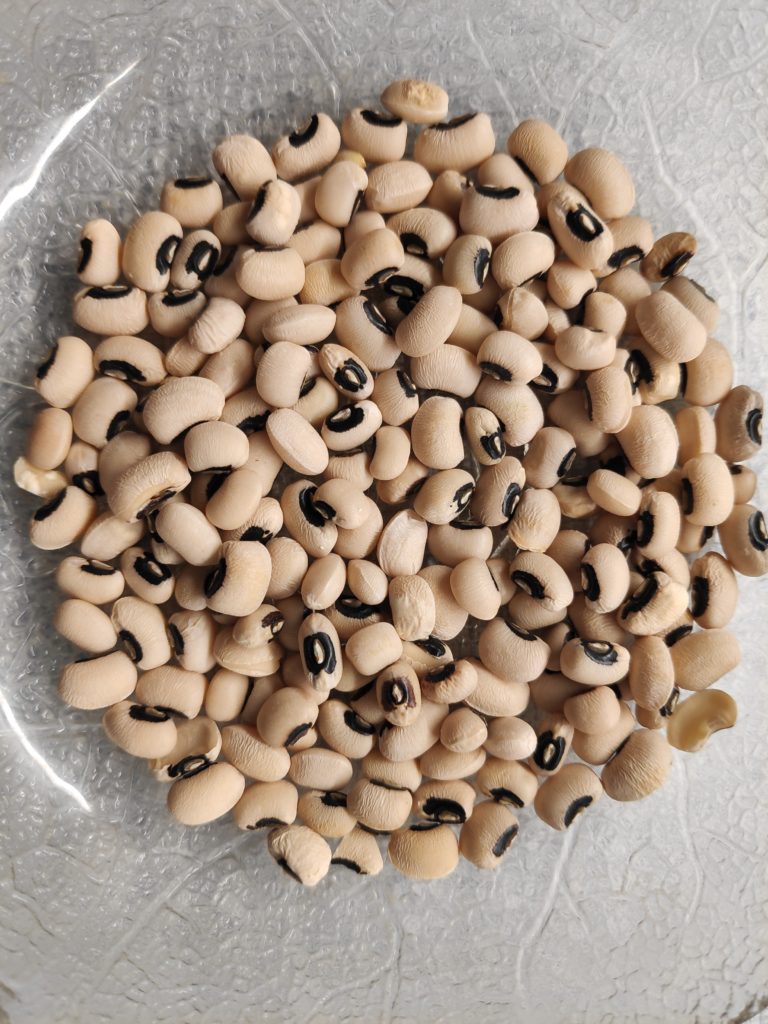
My interest in proteins has to do with getting sufficient in my diet. Most people will think of meat, fish and eggs as the normal sources of protein, but there are many plant sources as well, such as lentils, chick peas, black-eyed beans, almonds and sunflower seeds. Understanding the sources of protein in the foods we eat will help us plan a better diet, at perhaps a lower cost.
Where I live in Norway, meat and fish, as well as the processed products made from them are expensive. My husband and I have now reduced our consumption of meat and fish to about once each a week, and on the other five days of the week rely on other good sources of protein.
How much protein you need in a day depends on your height, gender, age, muscle mass and lifestyle (such as sedentary or active). According to healthline.com the average male needs about 56-91 grams of protein and the average female needs about 46-75 grams of protein per day.
Let’s look at the protein content of various types of food. The numbers given below are grams of protein in 100 grams of food. My source is The British Nutrition Foundation (https://www.nutrition.org.uk) or the packaging of the items I have in the house. Remember that many packaged foods will give you the amount of protein per 100 gr on the label.
Animal foods:
Beef – 31 gr
Pork – 31 gr
Chicken – 32 gr
Salmon – 24.2 gr
Tuna – 23.5 gr
Cod – 20.8 gr
Eggs – 12.5 gr
Whole milk – 3.3 gr
Cheddar cheese – 25.4 gr
Cottage cheese – 12.6 gr
Plant foods:
Red lentils – 23.8 gr
Chickpeas/garbanzo beans – 8.4 gr
Kidney beans – 6.9 gr
Black-eyed beans – 23.1 gr
Alubia beans – 22.5 gr
Peanut butter – 26 gr
Sunflower seeds – 23 gr
Pumpkin seeds – 25 gr
Sesame seeds – 18 gr
Almonds – 21 gr
Pecans – 9.2 gr
Hazelnuts – 15 gr
Walnuts – 15 gr
Remember that not all servings are of equal size. I hope you would never have 100 gr of peanut butter at one sitting, though 100 gr of meat is common. As you can see, many plant foods give a reasonable amount of protein.
When planning a meal, it is important to get a balance of the three major food types – protein, carbohydrates and fats.
Protein usually comes from meat or fish, but can also be from milk products including cheese, eggs and legumes (such as lentils and chick peas).
Carbohydrates are typically potatoes, pasta or rice, but can also be bread or other wheat products such as couscous.
Fats are often a part of the ingredients, as meat will often have fat with it, or it can be the cooking oil that is used in preparing the meal. Some fat will give more flavor to the meal, but too much will increase the amount of calories. Fats can be from animals or from plants.
In addition to these three main food types, it is necessary to eat food with a lot of fiber, such as raw vegetables and fruit. We also need a variety of minerals and vitamins from our food.
In future posts I will be looking at various ingredients that are typically used in dinner meals and looking at how they contribute to good nutrition. I will be looking at how we can vary our diet by increasing the variety of ingredients that are nutritious and tasty.